


"Teach music and singing at school in such a way that it is not a torture but a joy for the pupil; instill a thirst for finer music in him, a thirst which will last for a lifetime."
-Zoltan Kodaly
How music is taught in the elementary grades has changed over the years. For many that have been out of school for a few years, a music classroom would seem quite different than years past.
Music is part of the curriculum at Annandale Elementary School in all grade levels, K-5.
Penny Koets and Sydney Johnson are the two music teachers at AES. Koets has been with the school district since 1999 and Johnson is new to Annandale this school year.
Class rotations
Compared to other subjects taught at AES, the students are exposed to music less frequently. In kindergarten through fourth grade music class rotates with physical education and art. A typical K-4 rotation would be phy ed on days one, three and five; art on day two, and music on day four.
In fifth grade, STEM (science, technology, engineering and math) is added to the rotation. The fifth-grade rotation looks has phy ed on days one, three and five; music on day two, art on day four and STEM on day six.
"It is not easy teaching when you only see the students for 40 minutes once every four days," Koets said.
"It is even worse for the fifth-graders," Johnson said. "If the fifth-graders have music on a Friday, it will be 10 days before I see them again."
The Kodaly Method
"When I first came to Annandale, I felt really unprepared to teach elementary students," Koets said. "My college courses better prepared me to teach high school music. The music curriculum that I stepped into when I came here in ’99 was set up to teach one thing each month, whether you were finished or not. It was even more frustrating only meeting once every four days, because it was impossible to have the students internalize the musical concepts within the time frame allotted."
Koets eventually found a way to develop an effective curriculum with her musicians.
"I got tremendous help from Zane Schaefer, Lowell Larson, Ardis Nelson and Mark Nelson, the other music teachers in the district when I came here," Koets said. "Ardis Nelson took me to a Kodaly workshop at St. Thomas University during one of my first years here.
After that one initial workshop I was hooked on the Kodaly method and Ardis and I enjoyed many more Kodaly workshops together from that point on. I later took courses at Nebraska Wesleyan University for my Level I and Level II Kodaly Methodology courses, which is what I base my curriculum on here now at AES."
The Kodaly Method was started in Hungary by Zoltan Kodaly and a fellow colleague around 1935. Kodaly was critical of schools and how they approached the teaching of music. He was especially concerned that they only taught music in the secondary schools.
Kodaly worked on a long-term project developing a curriculum and teaching methods for elementary and middle school students.
"Today, the Kodaly Method is used all over the world," Koets said.
Kodaly goals
According to Koets, the following summarizes the goals and philosophy of the Kodaly methodology:
■ It improves music literacy in the schools.
■ Singing is the foundation of musical learning.
"To teach a child an instrument without first giving him preparatory training and without developing singing, reading and dictating to the highest level along with the playing is to build upon sand," said Kodaly.
■ Music education must begin with the very young.
■ Everyone is capable of being taught how to sing in tune and also how to be musically literate (unless there are extreme physical or developmental challenges).
■ Folk songs are essential with teaching young children music.
■ Incorporate games, movement, playing instruments, reading and writing music with singing.
■ Making music is joyful.
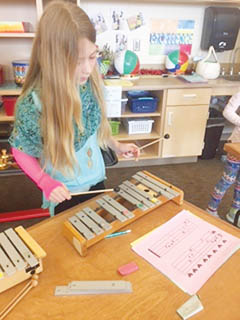
"I teach music through folk songs, games and other fun activities," Koets said. "The kids are constantly active with learning in the music room, whether it be through singing, movement, writing, and-or creating.
Koets’ teaching method using Kodaly focuses on a sequential foundation in which skills are taught. A musical skill is prepared with the students, then the skill is presented, and then the known skill is practiced. Over and over again she uses that prepare, present, practice cycle with the students to help them learn musical skills that will enable them be independent musicians.
"The language of music is like any other language, whether it be English or algebra," said Koets. "The symbols in the language of music represent pitch, they represent sound lengths."
AES goals
According to the Kodaly Method, the learning sequence can be simplified to the following: listen-sing-understand-read-write-create.
"I want our students to be able to pick up a piece of music and have the skills to read it without me being there," Koets said. "Later in life when they go to church or a funeral they will be able to pick up the song book and say, ‘I can read this.’
"But if kids get anything out of music in school I hope they will be able to say that making music is joyful and is something that they look forward to enjoying the rest of their lives, because music making is good for the soul and mind."
Fourth and fifth grade
In Johnson’s fourth- and fifth-grade classes students continue to learn the language of music, but not to the degree that Koets teaches in K-3.
"I am not well trained in elementary music and I am not certified in the Kodaly Method," Johnson said. "I did go to a Kodaly conference in October and Penny has been trying to bring me up to speed."
Johnson did not have a curriculum guide to go by when she started at the beginning of the 2016-17 school year.
"I have pretty much developed the curriculum day by day," Johnson said. "After each day my classes meet I write down all that we did and evaluate how it went."
In fourth grade students are expected to match pitch while singing, keep a steady beat, identify and perform rhythm patterns, distinguish different instruments; distinguish different music families, understand and exhibit the musical elements of dynamics; identify pitches on the staff according to the treble clef; and identify and perform melodic solfege patterns.
(Solfege is the alphabet of music. It teaches students about pitch, how to hear and sing harmonies, and how to write down music. The solfege scale is Do-Re-Mi-Fa-Sol-La-Ti-Do.)
Fifth-graders mostly carry forward the same music fundamentals taught in the previous grades.
Recorder Karate
Fourth- and fifth-graders learn to play the recorder in their AES music classes. The recorder is a plastic woodwind instrument with a whistle mouthpiece that has been used in elementary music classrooms for decades.
Johnson has introduced Recorder Karate as a fun way for the kids to enjoy learning to play the recorder.
During the course of the year the students can earn nine different karate belts as they master different songs on the recorder.
The white belt is the first belt and students earn it when they can play "Hot Cross Buns" on their recorders. The black belt is the top belt and children will earn it when the can play "Ode to Joy."
Benefits of music
Koets and Johnson both agree that there are many important benefits to providing music education in the schools. Music can enrich a student’s life and help students understand other courses they take in school.