
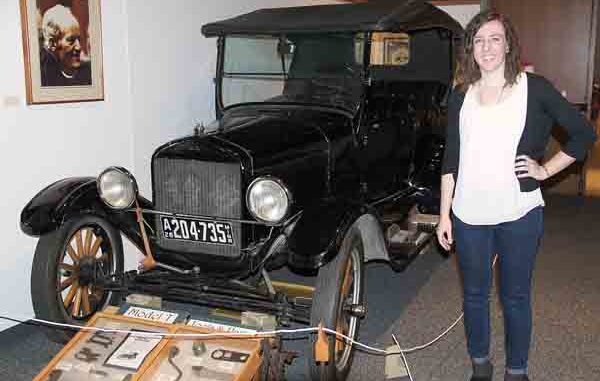
There is more than one way to tell a story, and Lori Nohner believes one of the best methods is to use artifacts.
"Physical objects help us build a story about what lives were like in the past," she said. "Objects are a starting point to tell the bigger stories about the things around them."
The curator at the Wright County Historical Society in Buffalo marks her first anniversary on the job this month. She is in her element when it comes to preserving artifacts that capture moments from the county’s past, then organizing, displaying and explaining them in engaging ways.
"I can sincerely say I love my job," she said.
A native of Mandan, North Dakota, Nohner attended the College of St. Benedict for her undergraduate studies, where she double majored in history and Spanish. A public history course at St. Ben’s helped Nohner to focus on museums for a future career.
"The museums part of it is what really stuck with me," she said. "I really enjoy working with the physical objects, what people used in their everyday lives."
She went on to pursue a master’s degree in museum studies from Colorado State University, then picked up some gritty, hands-on experience with a nine-month internship at the National Park Service’s Grant-Kohrs Ranch in Deer Lodge, Montana. The site commemorates the open-range ranching of the late 1800s, and a mansion there was once the headquarters of a 10-million acre livestock operation.
"All the furnishings were original to the family that lived there, which is really rare for a historic museum house," said Nohner. "Most historic homes have period items, but they aren’t necessarily original. But these were actually the family’s original things, right down to the pillowcases."
Nohner’s job there was to clean the entire mansion, from top to bottom, including historic carpets, windows, silverware and more.
"So I got really good practice and experience handling all these different materials, from textiles to leather saddles, metals, anything," she said. "That’s where I learned a lot of my practical skills."
Her first job came at Pioneer Trails Regional Museum in Bowman, North Dakota, where she spent two years as the only full-time employee at that location, doing everything from writing grants to routine maintenance.
"That’s where I learned how to run a museum," she said.
Knowing that her parents eventually planned to return to their native Minnesota, and with family in the area, Nohner was attracted to the job in Buffalo.
"I was also really excited to get back to the curatorial side of it, which is really where my passion is, to work with the exhibits and the collections and be a little more focused," Nohner said.
Extensive collection
With roughly 6,000 visitors a year, the Wright County Historical Society has more than triple the traffic of Nohner’s first museum. Its extensive collection, which Nohner conservatively estimates at more than 15,000 items, will take years to work into the museum’s computer records. A significant portion of her first year has been spent familiarizing herself with what is available.
Among items currently on display are a Model T car once owned by Humbert Humphrey, and a 32-piece one-man band contraption called the "The Nelsonian" that was featured at the World’s Fair in Chicago in 1933 and was built by Albert Nelson of Buffalo. Every item in the collection must come from Wright County. The western side of the county has good representation, though Nohner noted that strong historical organizations are also active at Annandale’s Minnesota Pioneer Park and at the Cokato Museum.
"You have to be organized," Nohner said of her favorite aspects of the job. "You have to be so methodical, otherwise things get lost."
The museum includes large display, research and activities areas, as well as storage and work space. Many storage items are kept in what look like large book cases but roll along tracks on the floor in an area where the temperature, humidity and light are all calibrated for preservation.
"I love making sure that these artifacts – these things that were part of people’s lives and that their families donated for us to take care of – I love making sure that they’re taken care of the best possible way and ensuring that they’re protected for the future," said Nohner, adding that the museum thinks in terms of preserving items for 100 years rather than a decade or two.
Upcoming exhibit
While planning, preparing and constructing an exhibit is a time-consuming task that takes anywhere from a month to a year, Nohner and other staff at the museum are currently preparing a World War I display that will coincide with the 100th anniversary of the nation’s entry into that war on April 6.
"It was a global war, and the U.S. was very much involved," said Nohner. "Even though it got involved late, the war affected everyone in the United States."
Challenges include choosing items to display, researching their local connections and the part they played in the wider war, then writing concise descriptions to match.
"We know that the majority of people don’t read much of the text. So how do we get them to read a short amount of text and still get our ideas across?" said Nohner.
Items in the display will include uniforms, gas masks and even a quilt made by women in Maple Lake as a fundraiser. Area residents who contributed had their names embroidered on the blanket.
"There are probably 90 names on there, some from Annandale and names from all over the western side of the county," said Nohner, adding that the museum is currently seeking an Army nurse or woman’s Red Cross uniform to include.
"More than the object itself, we look for the story that the object can tell," Nohner said.
In the end, pursuing and sharing that story is what a curator’s job is all about.