
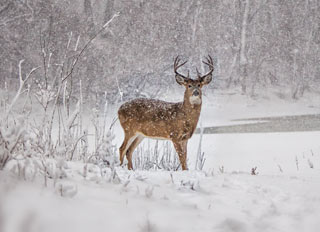
Nearing the holidays means that I am back out in the snowy woods looking for White-tailed Deer. The fall breeding season, also known as the rut, is long over, but females that were not bred during the first round are coming back into breeding condition now. The bucks had a short break from chasing does, but now the males are back at it.
Yesterday I spent three hours following a single large buck that was following his nose around the woods in search of a receptive doe during a heavy snowstorm. Each doe he encountered was inspected and evaluated before moving on to the next. The heavy snow doesn’t seem to slow him down at all. I must admit I really like the snowy environment and it makes for wonderful images. The snow gives an extra element to the pictures, enriching the story that each and every image needs to tell.
Complex story, little time
Wildlife photography is all about telling a complex story of nature by capturing just a fraction of a time. Literally, each wildlife image I take is just a split second of time. The trick is to be able to not only capture a pretty picture but also convey a story or message with each image. I often find it challenging to produce images that are more than just a portrait of the subject. In the wildlife photograph business, a portrait of a bird or animal is good but it doesn’t carry you very far. A good wildlife image not only tells you what the bird or animal is doing but also conveys action and intent of the subject.
So an image of a bird on a perch is good but the same bird flying is more desirable. A White-tailed Deer standing is good, but a deer running is better. A bird on a perch is good, but a bird braced against the wind and snow is better. A White-tailed Deer standing is good, but a White-tailed Deer with antlers and back covered in snow in the middle of a snow storm is better.
Against the elementsAll of this means that I am often heading out into the nature’s most severe elements when everyone else is heading in for shelter. The week before taking this image of the deer in snow, I was out photographing in pea-soup fog. I mean the fog was so thick that I had a hard time finding any critters to photograph. But I did manage to find some White-tailed Deer in the thick fog and was able to produce a number of images that I really liked and thought conveyed a real sense of wildness.
Yes, thick fog is just like falling snow, they are both natural elements that add a sense of time and place to an image. Rain is another element but it’s often difficult to photograph in the rain. A year ago I was in British Columbia, Canada photographing brown bears for a new book on bears. It was pouring rain every single day, as it does in that region, but I used this fact to my advantage. I have specialized rain gear for myself and also my camera gear. This allowed me to capture a number of outstanding images in pour rain. One image in particular shows a large brown bear’s head and shoulders. The bear’s fur is soaking wet and I was able to freeze many rain drops in mid-air showing the reason why this bear was so wet.
Elements in a wildlife photograph are what make the difference between a good picture and a great picture. This holiday season, if you are fortunate enough to get a camera for Christmas or perhaps take your old camera out into the elements and capture your own great wildlife images.
Happy holidays from my family to you and yours. Until next time …
Stan Tekiela, Victoria, is an author-naturalist and wildlife photographer. He travels the U.S. to study and photograph wildlife. You can follow him on twitter.com and facebook.com or visit his web page at www.naturesmart.com. His column appears regularly in the Advocate.